November 01, 2025|
 |
|
 Fully Hong
As electronic products evolve toward higher performance and miniaturization, PCB thermal management faces significant challenges. Heat accumulation from high integration can severely impact component performance and lifespan, potentially causing system failures. Traditional cooling solutions, such as larger heatsinks or fans, often face space and cost limitations. In this context, emerging advanced thermal materials offer unprecedented solutions for PCB designers and engineers.
Fully Hong understands the industry’s urgent demand for efficient heat dissipation. Therefore, this article explores the application principles, advantages, and practical potential of cutting-edge thermal materials, such as graphene and carbon nanotubes, in PCB heat management.
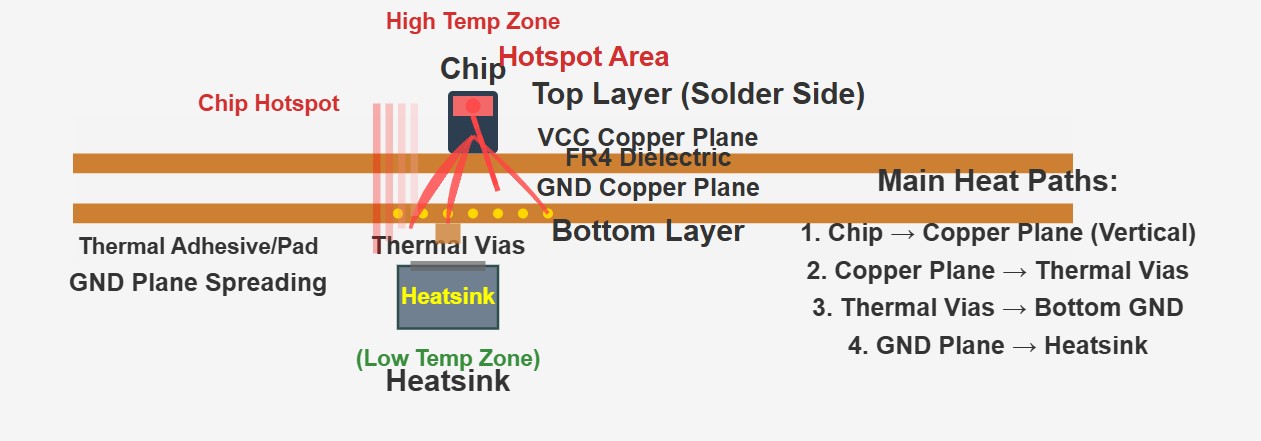
Modern electronics, ranging from smartphones to high-performance servers, present exponentially increasing chip power densities. This rise leads to the formation of localized PCB hotspots, where temperatures significantly exceed surrounding areas. Excessive heat accelerates component aging, reduces signal integrity, and can trigger thermal runaway.
Although traditional copper substrates conduct electricity well, their thermal conductivity (approximately 380–400 W/m·K) proves insufficient under extreme heat demands. Furthermore, space constraints make simply increasing copper thickness or heatsink size ineffective.
Key Insight: Thermal bottlenecks directly limit product performance and reliability.
To overcome conventional material limitations, scientists have turned to nanomaterials with exceptional thermal conductivity. Graphene and carbon nanotubes (CNTs) stand out because of their unique crystal structures and superior heat transfer properties.
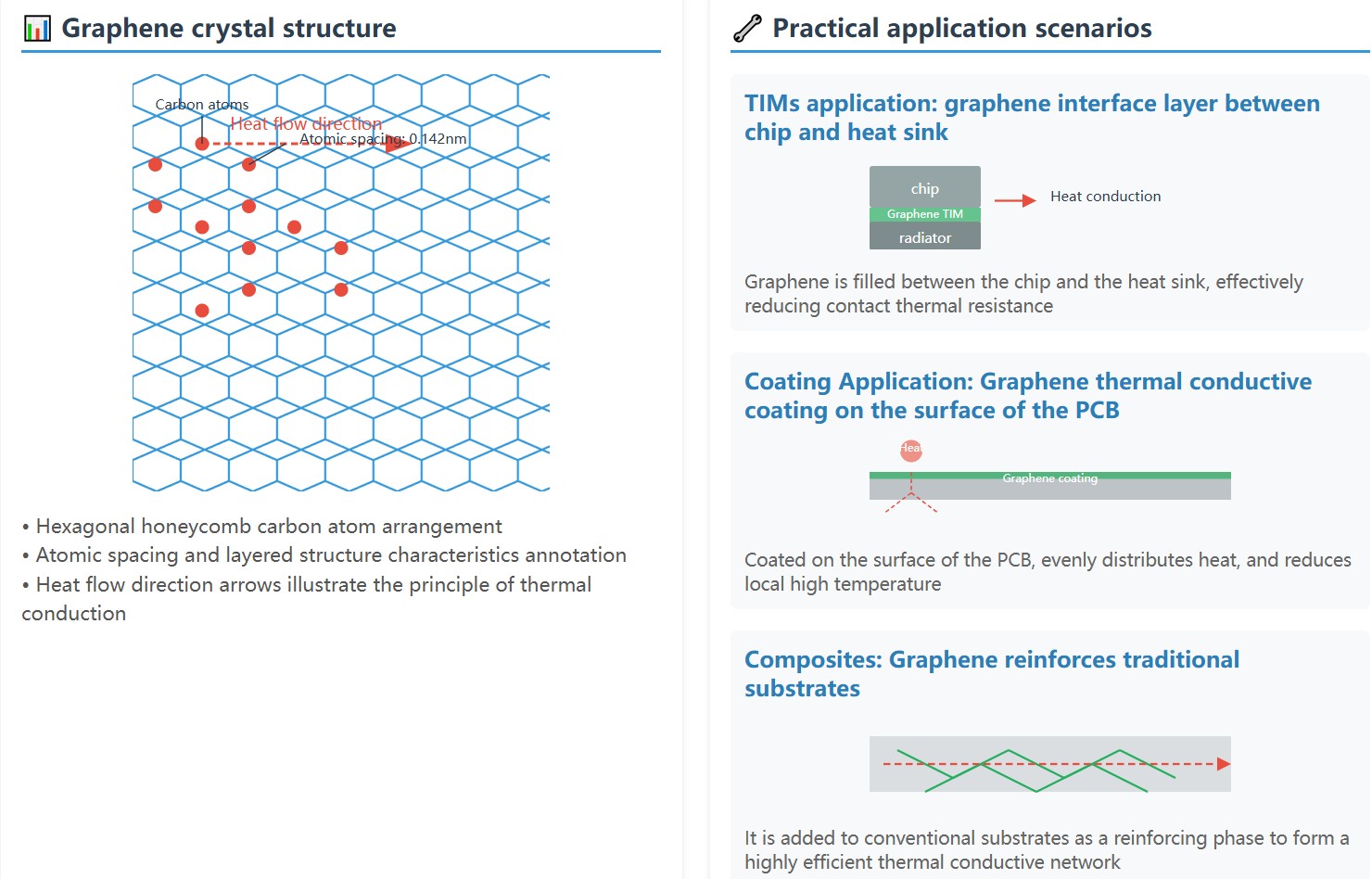
Graphene is a two-dimensional carbon crystal, just one atom thick. Its theoretical thermal conductivity reaches 5300 W/m·K, surpassing all known materials. The perfect hexagonal lattice enables phonons (heat carriers) to travel with minimal scattering.
In PCBs, engineers can apply graphene as:
Thermal Interface Materials (TIMs): Fill gaps between chips and heatsinks to lower contact thermal resistance.
Thermal Coatings or Films: Evenly distribute heat across PCB surfaces or layers.
Composite Substrate Materials: Reinforce traditional substrates, enhancing overall thermal performance.
Technical Note: Graphene’s high aspect ratio enables efficient thermal networks with minimal material.
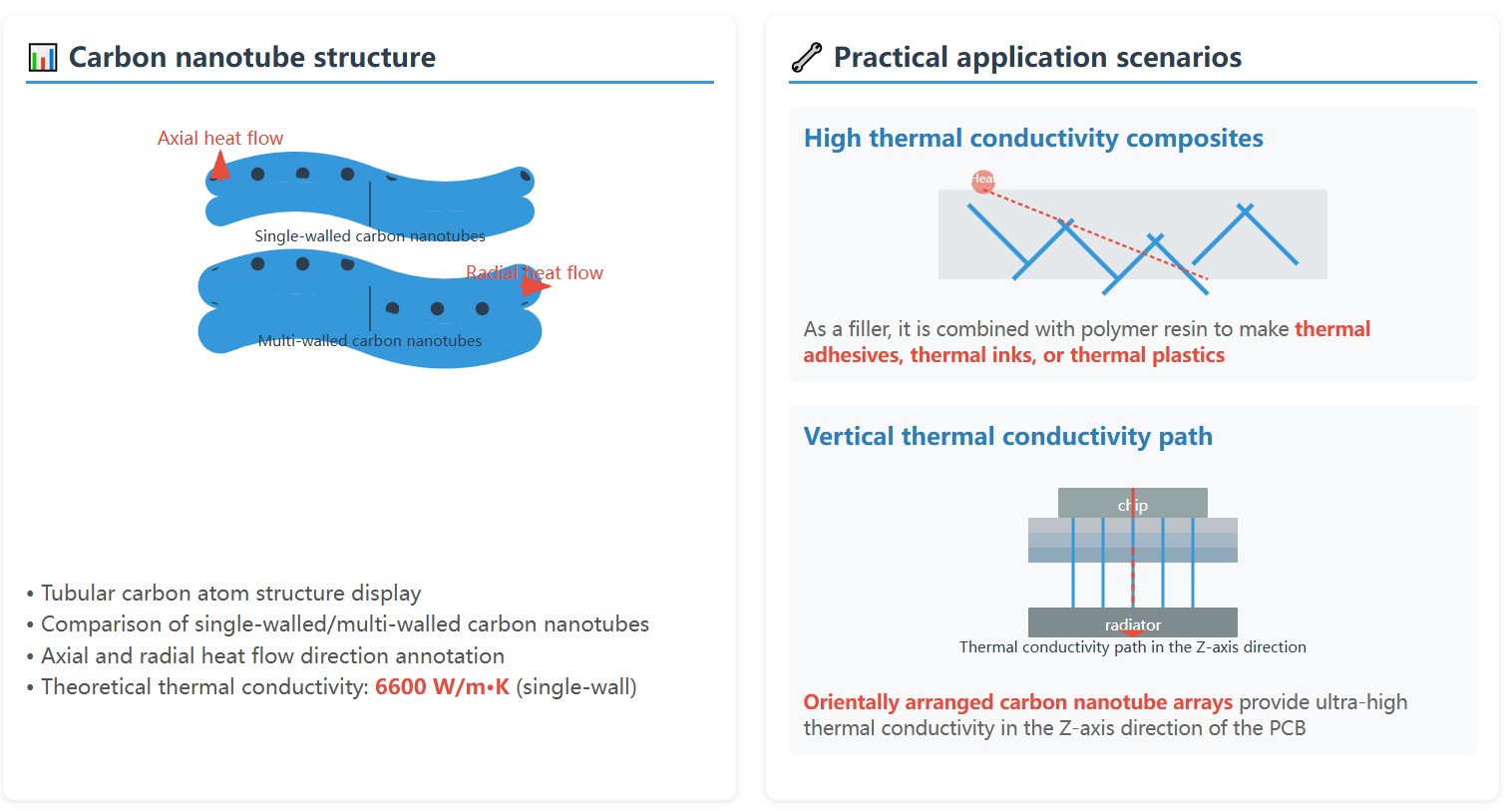
CNTs are hollow, one-dimensional nanostructures made of carbon. They resemble rolled graphene sheets. Single-walled CNTs reach 6600 W/m·K, and multi-walled CNTs up to 3000 W/m·K. Their high aspect ratio and anisotropic heat transfer properties make them ideal for creating directed thermal pathways.
Engineers utilize CNTs in PCBs as:
High-Thermal-Conductivity Composites: Fillers in polymer resins for thermal adhesives, inks, or plastics.
Vertical Heat Paths: Oriented CNT arrays provide ultra-high thermal conductivity along the Z-axis, quickly directing heat from chips to heatsinks.
Performance Highlight: CNTs’ vertical conductivity solves internal heat transfer bottlenecks in multilayer PCBs.
Integrating these advanced materials requires expertise and innovation. Fully Hong provides actionable, scalable solutions.
Optimized TIM Integration: Graphene-based gels or CNT array TIMs offer lower interface resistance and higher thermal conductivity than conventional thermal pads or greases. Consequently, high-power modules maintain performance.
Enhanced Thermal Vias and Microchannels: Traditional vias rely on copper. By using advanced materials, enhanced thermal vias or microchannel cooling efficiently transfer heat.
Important: IPC-A-600H standards ensure PCB structural integrity when integrating new materials.
High-Thermal-Conductivity Composite Substrates: Adding graphene, CNTs, or other fillers to epoxy (FR-4) or polyimide substrates substantially boosts thermal performance. This material-level optimization suits high-demand applications such as high-power LEDs or high-frequency modules.
Fully Hong transforms advanced thermal materials research into mass-producible, reliable products:
Technical Leadership: Our scientists and engineers possess deep expertise in graphene, CNTs, and other materials.
Customized Solutions: Fully Hong designs PCBs and PCBAs with advanced materials tailored to your project. Moreover, we provide end-to-end support from material selection to production.
Strict Quality Control: Following IPC and international standards, each PCB meets the highest reliability standards.
Cost-Effectiveness and Timely Delivery: Optimized supply chains and production processes ensure high-performance products at controlled costs and on schedule.
Partnering with Fully Hong ensures expert support in overcoming the increasing thermal challenges in modern electronics.
 Add: 803-804, Hisee International Commercial Center, Dongbin Road, Nanshan District, Shenzhen, China
 Tel: 0086-755-2664 8283
 E-mail: info@fully-hong.com


Copyright ©2025 Fully Hong Electronics Co.,Ltd. |A Professional And Reliable EMS/PCBA Partner.

 Previous