
Precision-engineered for high-frequency demands. Deliver uncompromised signal integrity & reliability.
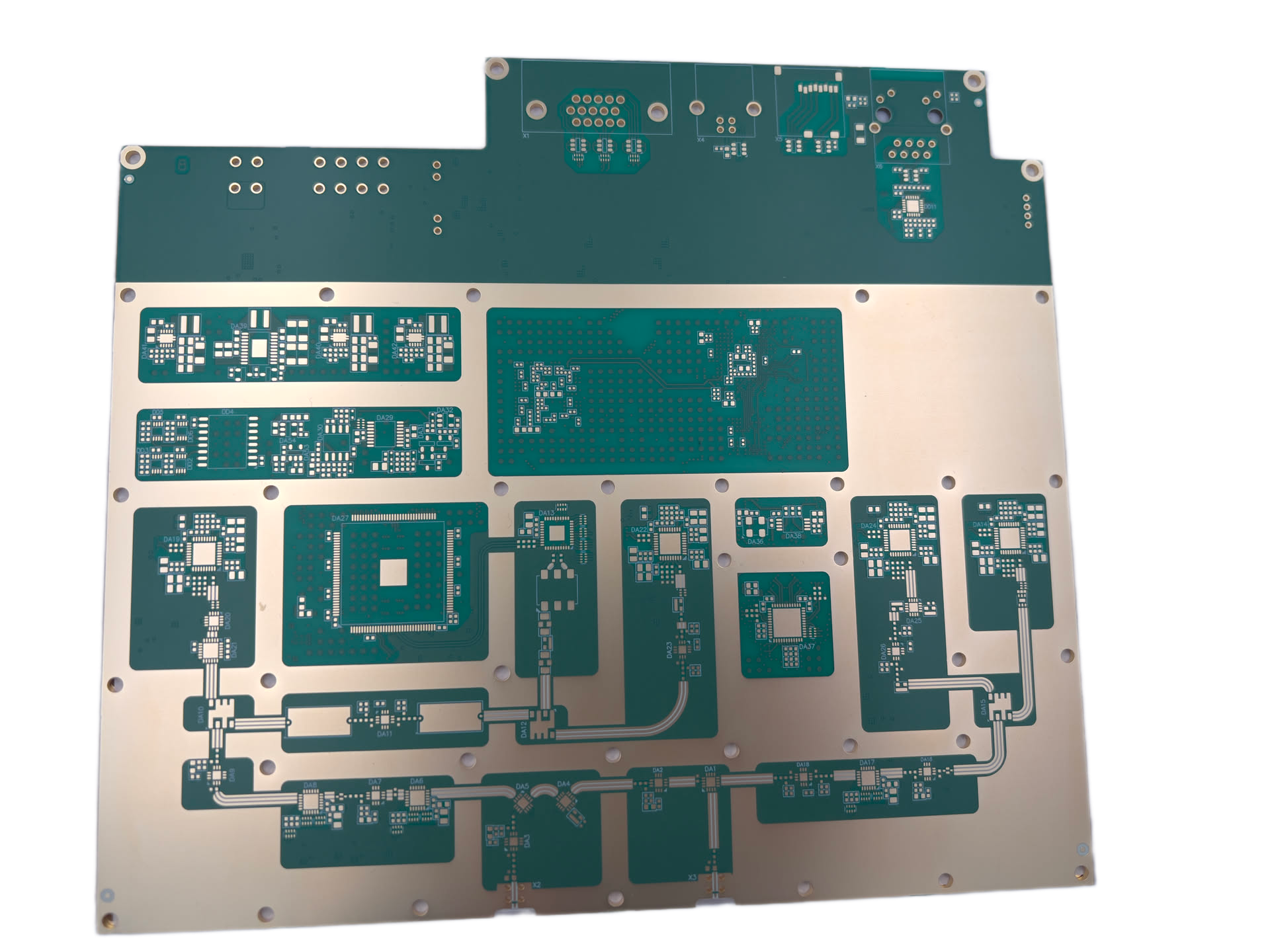
High-Frequency/RF PCB refers to a special type of PCB that operates at a frequency ≥1GHz and is specifically designed for high-frequency signal transmission. Its core value lies in ensuring the integrity of high-frequency signals (low insertion loss, low return loss, low crosstalk), serving as the core interconnection carrier for high-end electronic equipment such as 5G communication, millimeter-wave radar, and satellite navigation. Compared with ordinary FR-4 PCB, the core difference of High-Frequency/RF PCB lies in the extreme requirements for the dielectric properties of the substrate, among which dielectric constant (Dk) and dissipation factor (Df) are the key indicators determining high-frequency performance. At the same time, it needs to cooperate with high-precision impedance control, low-roughness conductors and special manufacturing processes to achieve low-loss and low-distortion transmission of high-frequency signals.



It has the highest strength-to-weight ratio among all available materials, significantly reducing product weight and cost. Suitable for military hardware, aerospace, defense equipment, automobiles, engines, power generation equipment and other applications requiring extremely high strength and lightweight. It has better thermal conductivity than similar materials, making it an ideal solution for high-frequency heat dissipation-sensitive scenarios.


RF transparent substrate with a thin gold layer on one side. Suitable for high-frequency PCB applications where performance specifications are critical and subject to military or aerospace requirements. It has high dielectric constant, low dissipation factor and good thermal stability.


Developed to meet the needs of complex digital network applications in the telecommunications industry, including next-generation optical transmission systems. Based on proprietary technology, it manufactures dielectric materials with low loss and ultra-high dielectric constant, showing low attenuation characteristics in a wide frequency range without metallization or other lossy technologies.


Hydrocarbon ceramic material, composed of conductive substrates with high dielectric constant (K) and extremely low dissipation factor (tan δ), and the dielectric constant changes with the material thickness. Suitable for substrates of integrated circuits, microwave devices, filters and other electronic components.


Patented product, using woven glass cloth reinforced hydrocarbon resin system/ceramic filler. Its electrical performance is very close to PTFE/woven glass cloth materials, and processability is similar to epoxy resin/glass cloth materials. It has excellent mechanical properties, dimensional stability and physical properties, high impact strength, fatigue resistance and stiffness at high temperatures, good toughness at low temperatures, and excellent compression set resistance in most applications.


Its electrical performance is very close to PTFE/woven glass cloth materials, and processability is similar to epoxy resin/glass cloth materials. Flame-retardant ABS laminate, designed for applications requiring UL94V-0 certification. The RoHS-compliant flame-retardant technology uses a proprietary flame retardant mixture to provide excellent thermal stability and char length control, ensuring the product obtains UL 94V-0 certification.


Made of glass fiber coating with pure PTFE sheets embedded. Compared with traditional non-glass fiber materials, it has more stable mechanical properties and more uniform dielectric constant. The extremely low dissipation value enables its practical effective value to reach above 35GHz, with a dielectric constant range of 2.17-2.40, which can fluctuate ±0.02 within the range of 2.14-2.40 for most thickness specifications; the dissipation factor is about 0.0009 at 10GHz.


Designed and manufactured to meet the requirements of products working at microwave frequencies, especially in wireless applications. It provides excellent thermal conductivity and low dielectric loss in a wide frequency range without using silver/gold ink or electroplating processes. It is a high-conductivity and low-loss FR-4 type, designed for high-frequency applications that need to handle high power.


FR4 glass epoxy resin laminate with embedded copper foil layer, featuring low dielectric constant and low loss tangent. Suitable for waveguide circuits or microstrip transmission lines (signals propagate along the board surface or through holes drilled in the board). It has good power dissipation capacity, and the low loss tangent can minimize reflections caused by impedance mismatch between different layers in the board or components in the system design.


Copper-clad laminate with solid copper surfaces on both sides of the core. The core is a composite material of phenolic resin and glass cloth impregnated with epoxy resin. Suitable for manufacturing high-power radio frequency circuits, including signal processing and transmission systems. It has excellent surface finish, can be processed into complex shapes, and has very good dimensional stability within a wide temperature range.


An advanced PCB material with low CTE, high Tg (TMA 180°C), halogen-free, low Dk and ultra-low loss. Specifically designed for cutting-edge high-speed applications, such as PAM-2 or PAM-4 signaling systems with 56Gbps per channel data rate.


Low loss, good electrical performance and thermal conductivity in the frequency range up to 18GHz. It has good mechanical strength, dimensional stability and moisture resistance. Very suitable for electronic circuits using 30MHz to 40GHz radio frequency
Dielectric Constant (Dk) is a core indicator for measuring the ability of high-frequency PCB substrates to store electric field energy, following the key rule that the lower the value, the more excellent the high-frequency performance of the substrate. Its value directly determines the signal transmission speed, and low-Dk substrates feature stronger frequency and temperature stability, which can effectively ensure impedance matching. The Dk value is inversely proportional to the signal transmission speed — the lower the value, the smaller the signal transmission delay. Meanwhile, the numerical fluctuation of low-Dk substrates can be precisely controlled, avoiding signal reflection and distortion caused by sudden impedance changes. For example, selecting substrates with Dk 3.0-4.0 for 5G Sub-6GHz scenarios increases the signal transmission speed by more than 20% compared with conventional FR-4 with Dk above 4.5; adopting low-dielectric materials with Dk 2.2-3.0 for 28GHz millimeter-wave scenarios controls the Dk fluctuation within ±3%, far better than the fluctuation range of more than ±5% for high-Dk materials, fundamentally ensuring the transmission stability of high-frequency signals.
Dissipation Factor (Df) is a core indicator characterizing the energy loss rate of high-frequency PCB substrates under the action of an electric field. The lower the value, the smaller the dielectric loss and the better the high-frequency signal transmission performance. Its value directly determines the attenuation degree of high-frequency signals and also affects equipment energy consumption and operating temperature rise. Low-Df substrates can greatly reduce energy loss during signal transmission, increase the effective transmission distance, and lower the temperature rise caused by losses, ensuring the long-term stable operation of equipment. For instance, in the 28GHz millimeter-wave frequency band, the signal loss per meter of ordinary FR-4 substrates with Df≈0.02 exceeds 5dB, while that of ultra-low loss high-frequency substrates with Df<0.005 can be reduced to within 1dB, increasing the effective signal transmission distance by 5 times. High-end substrates with Df<0.003 applied in 77GHz automotive radars not only eliminate the need for additional signal amplification modules, but also control the PCB temperature rise caused by dielectric loss within 5℃, ensuring the accurate and stable operation of radars.
 Add: 803-804, Hisee International Commercial Center, Dongbin Road, Nanshan District, Shenzhen, China
 Tel: 0086-755-2664 8283
 E-mail: info@fully-hong.com


Copyright ©2025 Fully Hong Electronics Co.,Ltd. |A Professional And Reliable EMS/PCBA Partner.
